Vintage Skull Digital Papers
In the landscape of digital content creation, visual assets are no longer just decorative afterthoughts; they are foundational components of brand identity and user engagement. For designers, hobbyists, and small business owners alike, the ability to produce high-quality, thematic backgrounds quickly is a significant workflow advantage. This is where specialized asset packs like Vintage Skull Digital Papers become indispensable tools. Rather than viewing these files merely as images, it is more effective to understand them as modular elements within a broader creative production pipeline.
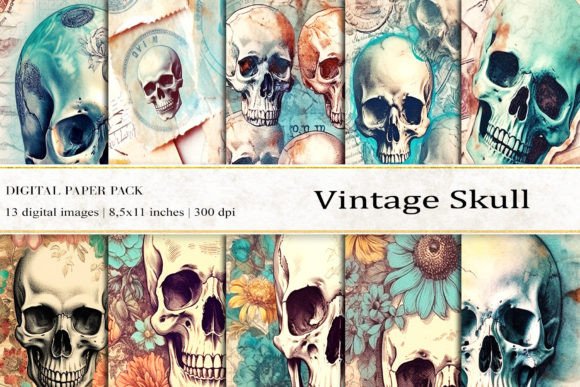
This specific collection consists of 13 distinct digital papers, each featuring unique interpretations of vintage skull motifs, including watercolor textures and journal-style layouts. Provided in JPG format at 8.5x11 inches and 300 dpi resolution, these files meet professional printing standards while remaining lightweight enough for web use. The fact that these images were generated using Midjourney adds a layer of modern efficiency to the process, allowing for intricate details and consistent stylistic cohesion that might take hours to paint manually. Understanding how to integrate these assets into your daily operations can streamline everything from social media planning to physical product manufacturing.
Integrating Visual Assets into Creative Workflows
The primary value of a digital paper pack lies in its versatility across different stages of a project lifecycle. Whether you are designing a limited-edition merchandise line, creating content for a blog, or organizing a personal planner, having pre-made, high-resolution backgrounds removes the friction of starting from a blank canvas. The "Vintage Skull" theme, in particular, appeals to niche markets ranging from gothic fashion enthusiasts to alternative lifestyle brands. By utilizing these ready-to-use textures, creators can maintain visual consistency without sacrificing time.
When implementing these papers into a workflow, consider the source of the design. Because the images were created with AI technology, there is a notable emphasis on texture and organic variation. Watercolor effects, for instance, provide a softness that contrasts effectively with the sharper lines often found in typography. This contrast is crucial for legibility and aesthetic balance. When placing text over these backgrounds, one must account for the varying density of the skull illustrations. Lighter areas offer better readability for white or light-colored fonts, while darker, ink-heavy sections may require drop shadows or semi-transparent overlays to ensure the message remains clear.
Pre-Production Planning and Asset Management
Before diving into design software, proper organization is key to efficiency. A set of 13 files is manageable, but if you work with multiple themes, a structured folder system prevents bottlenecks. Name your files descriptively—for example, vintage_skull_watercolor_01.jpg—rather than generic labels like image_452.png. This practice saves minutes per file during large-scale projects, which accumulate into hours over time.
Furthermore, verify the technical specifications early in the process. While 300 dpi is ideal for print, web browsers render images differently. If you intend to use these papers for website headers or email newsletters, you may need to optimize the file size without compromising quality. Tools like Photoshop or online compressors can reduce the kilobyte count while maintaining visual integrity. Keeping both the high-res original and a web-optimized copy ensures you have the right asset for the right medium, preventing pixelation on screens or unnecessarily slow load times.
Practical Use Cases Across Industries
The utility of Vintage Skull Digital Papers extends far beyond simple scrapbooking. Their application spans various professional domains, each requiring a slightly different approach to integration.
- E-commerce and Product Design: Small business owners selling apparel, stickers, or home decor items can use these papers as direct prints for fabric or sublimation blanks. The 8.5x11 inch dimension is standard for many craft printers, making it easy to test prints before committing to bulk orders. Additionally, these designs serve as excellent mockup backgrounds for showcasing products, adding an atmospheric context that enhances perceived value.
- Content Creation and Blogging: For bloggers and educators, visual breaks improve reader retention. Using a vintage skull background for featured images or section dividers can establish a strong brand voice. If your content revolves around history, art, or alternative culture, these papers reinforce the thematic narrative without requiring custom illustration skills.
- Event Planning and Stationery: Invitations, save-the-dates, and party favors benefit from tactile aesthetics. Even when designing digitally, simulating the look of aged paper or watercolor stains adds depth. These papers can be layered with vector graphics or clipart to create cohesive invitation suites. The consistency across the 13 variations allows for mixing and matching, ensuring that different parts of an event’s branding feel unified yet dynamic.
- Personal Productivity: Hobbyists and planners often customize their digital or physical journals. These pages are perfectly suited for printable planner inserts, bullet journal spreads, or photo album backdrops. The journal-page style variants provide structured spaces for notes, bridging the gap between artistic expression and functional organization.
Technical Considerations and Quality Control
While AI-generated art offers speed and creativity, it requires a human eye for final quality control. When downloading or purchasing sets like this, inspect the edges of the patterns. Seamless tiling is not always guaranteed in generative outputs, so check if the skulls repeat in a way that looks natural or jarring. For single-use designs like invitations, repetition is less of an issue. However, for wrapping paper or wallpaper applications, you may need to edit the edges in a raster editor to ensure smooth transitions.
Color management is another critical factor. Screens display color in RGB (Red, Green, Blue), while printers use CMYK (Cyan, Magenta, Yellow, Key/Black). A vibrant blue on your monitor may appear duller in print. Always convert your JPG files to CMYK mode if you are sending them to a professional printer. This step helps predict how the watercolor gradients and black ink tones will translate onto physical stock. Testing a single print on the actual material you plan to use—whether it’s cardstock, fabric, or vinyl—is the only way to guarantee accuracy.
Enhancing Workflow with Layering Techniques
To maximize the potential of these digital papers, experiment with layering. Instead of using the skull image as a flat background, place it on a lower layer and overlay it with solid colors or textures at reduced opacity. This technique can soften the intensity of the skulls, making them suitable for more subtle applications, such as letterhead or corporate branding where overt imagery might be too aggressive. Conversely, increasing the contrast and saturation can make the designs pop for social media thumbnails or promotional banners.
Another effective strategy is combining these JPGs with vector elements. Vectors scale infinitely without losing quality, making them ideal for logos, icons, or crisp typography. Placing a clean, sans-serif logo over a chaotic, vintage skull background creates a striking juxtaposition that draws the eye. This hybrid approach leverages the strengths of both mediums: the organic feel of the AI-generated paper and the precision of vector graphics.
Long-Term Value and Adaptability
Digital assets are most valuable when they remain relevant over time. The "vintage" aesthetic has a timeless quality, avoiding the pitfalls of fleeting trends. This makes the Vintage Skull Digital Papers a sustainable investment for your creative library. As your business or creative practice evolves, these papers can adapt. A design used for a Halloween-themed campaign today can be repurposed for a year-end sale or a special edition product launch next year by simply changing the accompanying text or color accents.
Moreover, owning these files grants you full usage rights for commercial projects (subject to the specific license provided by the creator). This freedom allows you to scale your output. You are not limited to creating one item at a time; you can batch-produce marketing materials, packaging designs, or digital downloads. The ability to generate diverse visuals quickly is a competitive advantage in fast-paced markets.
Ultimately, the goal of integrating tools like Vintage Skull Digital Papers is to remove barriers between idea and execution. By handling the heavy lifting of background creation, you free up mental energy to focus on messaging, strategy, and customer connection. Whether you are a seasoned graphic designer looking to speed up your turnaround times or a hobbyist wanting to add a touch of elegance to your crafts, these 13 high-resolution papers offer a robust foundation for your next project. Embrace the workflow benefits, respect the technical nuances of print and digital media, and let the visuals enhance your communication rather than distract from it.